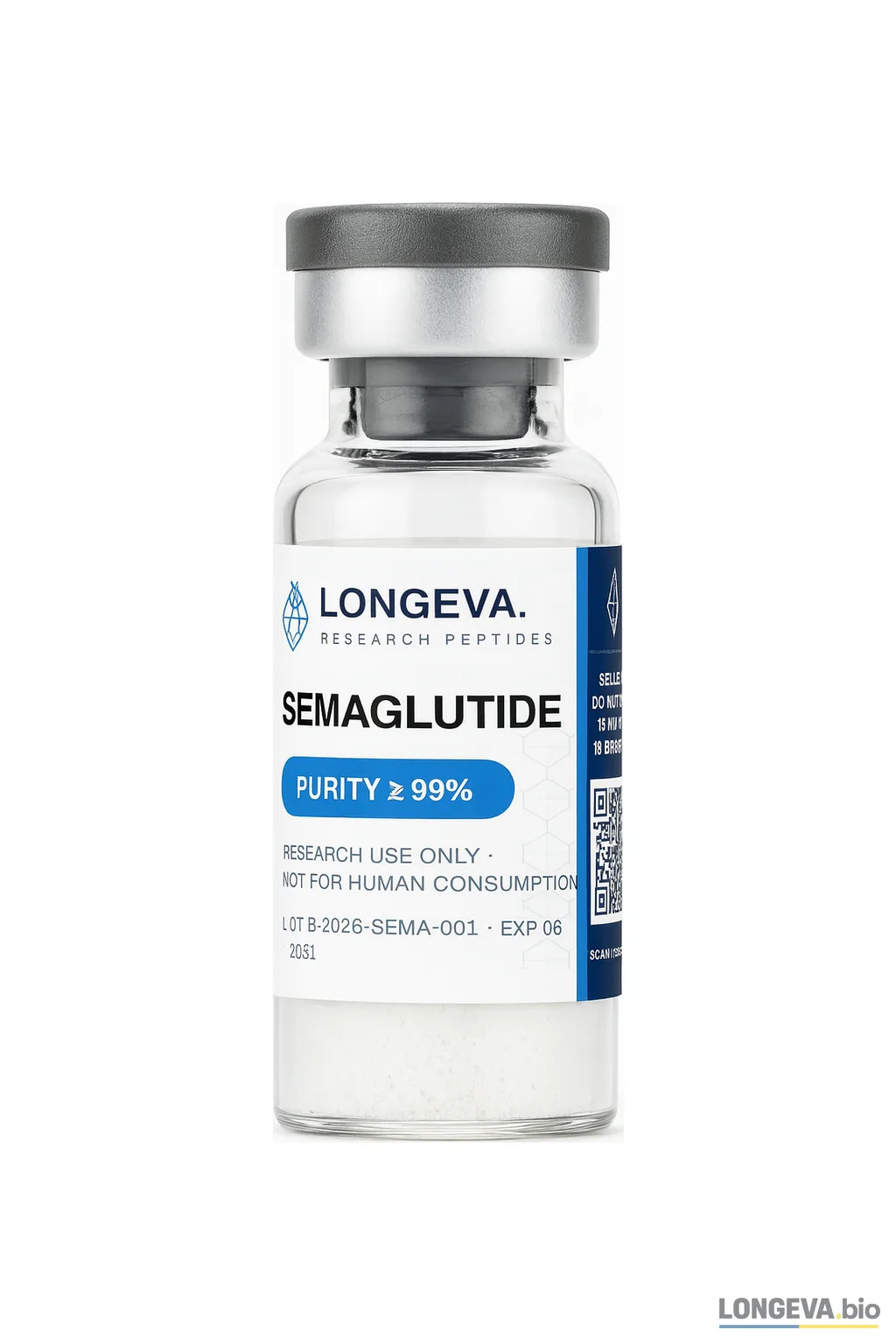
When you order a research peptide, what waits inside the vial is not a liquid but a dry white powder or a dense "cake" at the bottom. This is neither a mistake nor a defect, that is what a lyophilized peptide looks like, a reagent from which the manufacturer has deliberately removed the water by freeze-drying. In this form the molecule keeps its structure far longer than it would in solution. Below we cover what lyophilization of peptides is, why research peptides ship specifically as a powder, how this affects stability and storage, and what your next step is. Everything stated here concerns handling a laboratory reagent and is not a human-use instruction.
What lyophilization (freeze-drying) is
Lyophilization, or freeze-drying, is a way to remove water from a substance without exposing it to heat. First the peptide solution is deeply frozen, then inside a vacuum chamber the water passes from the solid state straight into vapor, skipping the liquid phase. This process is called sublimation. The result is a dry, porous mass left at the bottom of the vial, the same peptide, but now without water.
Why not simply evaporate the water with heat? Because peptides are fragile molecules, and high temperature destroys their structure (denaturation). Lyophilization lets you dry the reagent "in the cold," keeping the molecule intact. That is precisely why lyophilization of peptides became the industry standard for biologically active compounds: from enzymes and vaccines to research peptides such as GLP-1 agonists.
A finished lyophilizate looks like a white or near-white dry deposit, often called a "cake" or powder. It occupies only part of the vial's volume, so do not be alarmed if the powder looks "small": the peptide mass matches exactly what the label states, no matter how much space it takes up.
Why a dry powder is more stable than a solution
The main reason peptides ship as a powder is that water is the enemy of stability. In a liquid environment the peptide molecule gradually breaks down, and several processes work against it at once.
- Hydrolysis. Water molecules chemically attack the peptide bonds and slowly "cut" the chain. No water, no hydrolysis. A dry reagent is practically free of this process.
- Microbial contamination. In a preservative-free solution bacteria multiply quickly. A dry powder gives them no medium to grow in.
- Aggregation and oxidation. In a liquid, molecules stick together and are oxidized by oxygen more readily. In the dry state this mobility is sharply limited.
There is also a purely logistical reason. A liquid reagent requires an unbroken cold chain, it would have to be shipped and stored frozen from the manufacturer to the lab, and any temperature lapse spoils the material. A dry lyophilizate is far more tolerant of transport: it stays stable at ordinary temperatures long enough to survive delivery and does not need dry ice in every package.
Put simply: in dry form the reagent "sleeps" and barely degrades, which is why the manufacturer can guarantee the stated purity and mass by the time the vial reaches you.
One important caveat: lyophilization does not remove water from the sample completely. A small amount of residual moisture, bound to the peptide molecule and the vial walls, always remains in the dry deposit. It is one of the parameters controlled during manufacturing, and the lower it is, the slower the residual degradation processes run, even in the dry state. That is also why the vial's seal and protection from airborne moisture (covered below) matter for a dry powder much the same way they do for a solution, just at a far slower pace.
What you receive and how to check the vial
After unpacking the shipment, inspect the vial, this is the simplest first-line quality check of the reagent.
- Color and appearance. A normal lyophilizate is white or near-white. It can be a dense "cake," a fluffy cake, or a fine powder; all three are acceptable and depend on the drying conditions.
- Deposit integrity. Sometimes during transport the "cake" partly breaks off the bottom and crumbles, this alone is not a problem as long as the powder is dry and has not changed color.
- Signs of a problem. Yellowing, moisture, clumped lumps, or visible liquid inside a dry vial are reasons to be wary about storage or transport conditions.
- Documentation. Batches come with a certificate of analysis (COA) confirming the purity and mass of that specific batch; you can check it in the public COA archive.
If you want to know how a specific compound is characterized in research, turn to our monographs, for example, the semaglutide monograph, which gathers data on the molecule, its mechanism, and references to studies.
Storing a lyophilized peptide before reconstitution
As long as the vial is sealed and dry, it is undemanding, but a few rules for storing a lyophilized peptide are worth following so the reagent survives intact until you work with it.
- Cold and dark. It is best to keep the dry lyophilizate in the refrigerator at 2–8 °C, and for long-term storage in the freezer. A dry powder on its own tolerates freezing reliably; what happens to the solution after reconstitution depends on the specific peptide, more on that below.
- Away from light and moisture. Keep the vial in its factory box or an opaque container; light and humidity are the main external drivers of degradation.
- Do not open early. Break the stopper's seal only when you are ready to reconstitute the reagent. A sealed vial is protected from airborne moisture.
- Let it warm up before opening. Before reconstitution, wait for a cold vial to reach room temperature, this reduces condensation inside.
Storage after reconstitution: why there is no single rule
No. Whether to freeze it in aliquots, keep it refrigerated only, or use it right away, the behavior of a reconstituted peptide depends on the specific molecule, the diluent chosen, and how stable that particular compound is in solution. There is no universal rule that applies to "any peptide."
The powder form by itself guarantees nothing about this later period: lyophilization solves the stability problem before you add water. Once reconstituted, other variables take over, the peptide's own chemical structure (for example, tirzepatide's fatty-acid chain behaves differently in solution than a molecule without such a tail), the buffer or diluent chosen, concentration, and how many times the vial has been opened.
So instead of a blanket rule about freezing the solution, check the documentation for that specific compound. Our Tirzepatide and Semaglutide docs pages spell out how long and under what conditions those specific molecules hold up once dissolved, including aliquot-freezing conditions where that applies. For a peptide not covered in the docs, use the general principles below and, if needed, check with the lab running your analysis.
A batch's certificate of analysis (COA) confirms the identity and purity of your specific vial at the time of testing, it is not a storage instruction for the solution: a COA does not replace peptide-specific documentation, it only confirms that the material in your vial matches what was stated.
- Does the documentation for this specific compound give guidance on the reconstituted solution?
- Does the diluent you used match what is described for that molecule?
- Is the solution clear, with no cloudiness or particles? That is a sign of degradation regardless of storage temperature.
- If you plan long-term storage, aliquoting reduces the number of freeze-thaw cycles any single portion goes through, that is a general principle for handling peptide solutions, not a stability guarantee for every molecule.
The next step: reconstitution
A dry powder is not used in research on its own, to get a liquid of known concentration, it must be reconstituted, that is, dissolved in a sterile diluent. This process is called reconstitution. This is where beginners most often go wrong: they hit the powder with a direct water jet, shake the vial instead of swirling it, or confuse milliliters with syringe units.
To get it right the first time, we have prepared a detailed step-by-step guide: how to reconstitute peptides with bacteriostatic water. It covers diluent choice, water-adding technique, concentration math, and reading the dose on a U-100 insulin syringe. And to avoid manual math, use our reconstitution calculator, it shows the concentration and draw volume instantly.
In short
- A lyophilized peptide is a reagent from which water has been removed by freeze-drying; a white powder or "cake" is left at the bottom of the vial.
- Peptides ship as a powder because the dry state protects the molecule from hydrolysis, microbial contamination, and oxidation and requires no strict cold chain.
- Lyophilization does not remove moisture completely; residual moisture, and how well the vial is protected from light and airborne moisture, affect the dry powder's shelf life.
- Before reconstitution the dry lyophilizate is stored cold and dark; a dry powder tolerates freezing well.
- After reconstitution the rule depends on the specific peptide and diluent, so check the documentation for that specific compound (for example, Tirzepatide or Semaglutide) rather than a general rule.
- The next step is reconstitution per a separate guide; a calculator helps compute the concentration.
Ready to pick a reagent for your research? Browse the peptide catalog or go straight to the popular items: Semaglutide, Tirzepatide, and Retatrutide. Batches come with a certificate of analysis (COA).
Everything stated here concerns handling a laboratory reagent and is intended solely for research purposes. Not for human use.