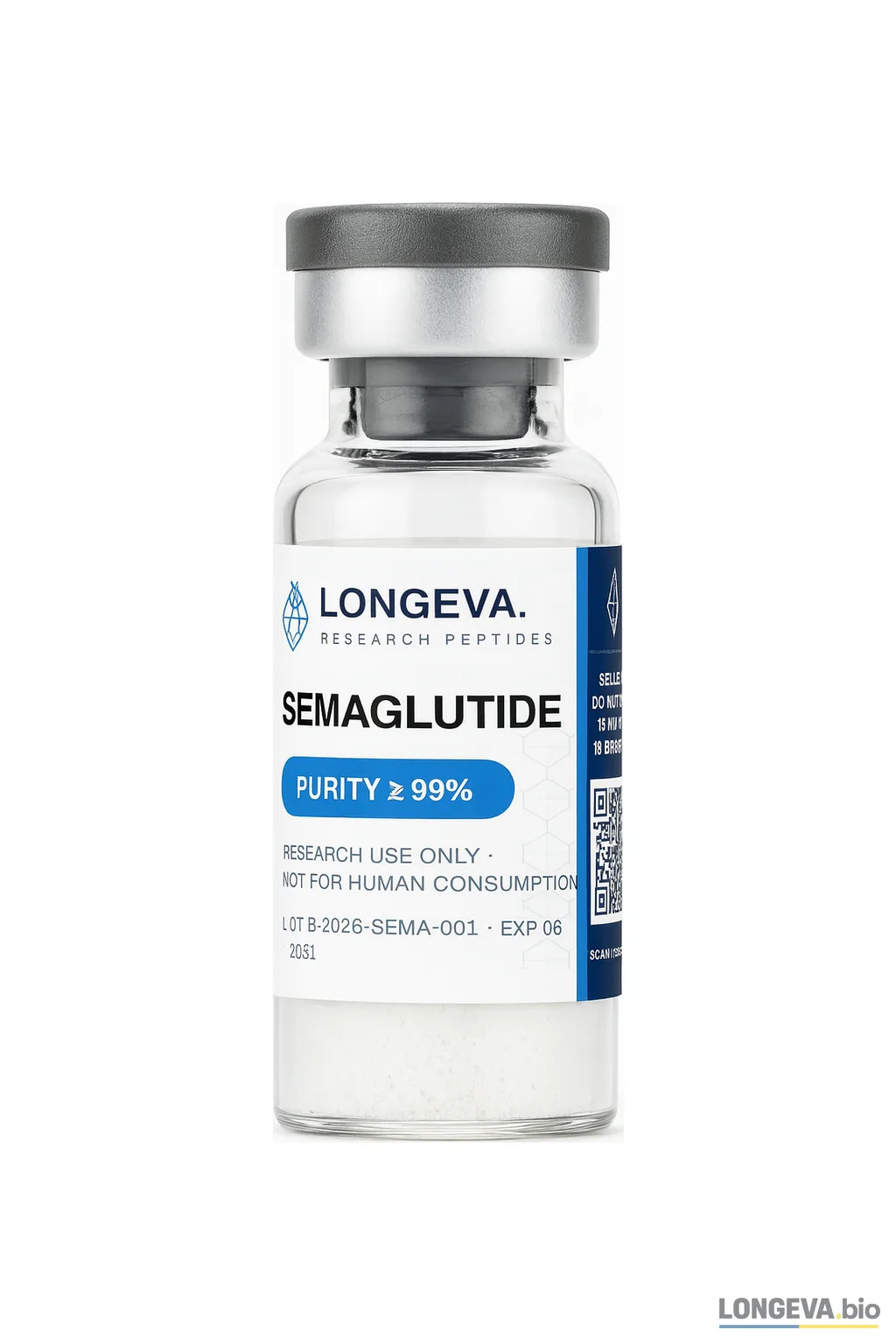
Short version: Rybelsus is a registered prescription drug sold as tablets. Longeva's semaglutide lyophilizate is a lab sample with research use only (RUO) status. Both get mentioned alongside the word "semaglutide," and that is the only thing the two products have in common. Form, regulatory status, purpose, and the document that describes each one are all different.
Longeva does not manufacture, sell, or represent Rybelsus, Ozempic, Wegovy, or any other branded prescription semaglutide product. These names appear here only to explain the difference between a finished drug and a laboratory reagent.
The difference at a glance
| Parameter | Rybelsus | RUO semaglutide (Longeva) |
|---|---|---|
| Product type | Registered prescription drug | Research sample (research use only) |
| Form | Solid tablet taken by mouth | Lyophilized powder in a vial |
| Composition | Semaglutide in an approved formulation with the excipient SNAC | Active substance; analytical methods and results are stated in the batch's own COA |
| Purpose | Medical use per approved labeling, under a doctor's supervision | Laboratory research only, not intended for humans or animals |
| Primary document | Official prescribing information | Product sample page, LOT number, and Certificate of Analysis (COA) |
Why the oral route needs its own context
Rybelsus is not simply semaglutide taken by mouth instead of by injection. Peptides like semaglutide are normally broken down by digestive enzymes before they get anywhere useful, which is why Novo Nordisk's oral formulation includes the excipient SNAC, an absorption enhancer that helps a portion of the active substance cross into the bloodstream from the stomach. That is a whole engineered finished product: the formulation, the manufacturing process, and the quality controls belong to that specific product, not to the semaglutide molecule in general.
The practical consequence follows from that. Data on the efficacy, tolerability, or stability of the Rybelsus tablet describes the Rybelsus tablet. Carrying those conclusions over to injectable semaglutide, to a different brand, or to a laboratory reagent is not valid, even when the active substance carries the same name.
What the STEP trials show, and what they don't
STEP-1 and STEP-2 studied injectable semaglutide, not a tablet. STEP-1 enrolled adults without diabetes and compared subcutaneous semaglutide against placebo under a defined protocol [1]. STEP-2 enrolled adults with type 2 diabetes under a different trial design [2]. In both trials, participants received an injection on a specific schedule, under medical supervision, inside a randomized study.
The injectable form of semaglutide, the route of administration, and the protocol of STEP-1 and STEP-2 are all different from the Rybelsus tablet, so their results cannot be presented as evidence for the oral drug's efficacy or safety. The same logic runs the other way: a clinical publication about a finished drug does not confirm the identity or purity of a laboratory sample that happens to carry the same name on its label.
Three questions before you trust any offer
- What is actually on offer: a registered prescription drug, or a lab sample carrying RUO status?
- Who is the manufacturer, and what document describes this specific product, not the substance class in general?
- Is data from a different semaglutide formulation, a different dose, or a different trial being presented as evidence for what is being offered right now?
If a page or a seller blurs those categories, the price and the promises coming from that source should not be read as one coherent body of evidence.
How to check brand information
Before trusting a description of Rybelsus or any other branded drug, check three things: who the manufacturer is, what form the product is sold in, and which jurisdiction issued the document the seller is citing. Official U.S. labeling in DailyMed is a legitimate source for the American market [3], but it does not replace Ukrainian registration information for the drug. It is also worth checking the document's revision date: indications, warnings, and usage instructions get updated over time.
How to verify a research sample's batch through its COA
Checking a batch of Longeva's laboratory semaglutide is simpler and more transparent than checking a branded drug at a pharmacy, because the COA is published openly:
- Find the LOT number on the vial and on the outer packaging.
- Open the semaglutide PDF in the COA archive.
- Cross-check the substance name, the analytical methods (HPLC, identity), and the result units against what the label says.
- Log the batch's receipt date and the PDF link in your own lab record.
The same steps are laid out on the semaglutide sample page. They apply to laboratory material and have nothing to do with verifying a prescription tablet's authenticity at a pharmacy, which has its own, separate controls.
One molecule, several products
Rybelsus, Ozempic, and Wegovy are all built around one substance, semaglutide, yet they remain different brands with different forms, doses, and approved uses. We covered the brand-versus-molecule distinction, and how the injectable form differs from the oral one, in our piece on Ozempic and semaglutide. If you are interested in the molecule itself, outside the context of any one brand, its mechanism and clinical background are covered in the semaglutide wiki entry.
See it on Longeva
If what you actually want is the laboratory semaglutide sample, not the finished drug: the sample page shows current pack sizes and links to the COA archive for published batches.
This material is for reference only and is not medical advice, a diagnosis, or usage instructions. Rybelsus, Ozempic, and Wegovy are trademarks of their respective owners. Longeva does not manufacture, sell, or represent these brands; Longeva's products are intended for laboratory research only (RUO) and are not intended for use in humans or animals.
Sources
- Wilding JPH, et al. Once-Weekly Semaglutide in Adults with Overweight or Obesity. New England Journal of Medicine. 2021. doi:10.1056/NEJMoa2032183
- Davies M, et al. Semaglutide 2·4 mg once a week in adults with overweight or obesity, and type 2 diabetes (STEP 2): a randomised, double-blind, double-dummy, placebo-controlled, phase 3 trial. The Lancet. 2021. doi:10.1016/S0140-6736(21)00213-0
- U.S. National Library of Medicine. DailyMed: RYBELSUS, semaglutide tablet. Check the current revision at the time of reading.