The names TB-500, Thymosin Beta-4, and Tβ4 are frequently placed next to each other in research-peptide catalogs and are sometimes used interchangeably. Chemically, that is inaccurate.
Full-length Thymosin Beta-4 (Tβ4) is a 43-amino-acid peptide. TB-500 is a short synthetic fragment derived from residues 17–23 of Tβ4; FDA describes TB-500 as the N-acetylated heptapeptide Ac-LKKTETQ.
This distinction matters because findings obtained with full-length Tβ4 cannot automatically be treated as findings obtained with TB-500.
In short: Tβ4 is the full 43-amino-acid molecule. TB-500 is a 7-amino-acid fragment. They are related, but they are not chemically identical.
TB-500 vs Thymosin Beta-4
| Property | Thymosin Beta-4 (Tβ4) | TB-500 |
|---|---|---|
| Molecule | full-length peptide | synthetic Tβ4 fragment |
| Length | 43 amino acids | 7 amino acids |
| Key sequence | contains multiple functional regions | Ac-LKKTETQ |
| Relationship | parent molecule | residues 17–23 of Tβ4 |
| Same compound? | No | No |
Classical structural studies established full-length Tβ4 as a peptide containing 43 amino-acid residues. Different regions of this sequence have been associated with different biological activities. The central actin-binding region includes LKKTETQ, but this sequence represents only part of the full Tβ4 molecule.
In its 2026 materials, FDA specifically describes TB-500 as N-acetyl-LKKTETQ, a seven-amino-acid fragment derived from full-length Thymosin Beta-4.
Why are TB-500 and Tβ4 often confused?
TB-500 is derived from a functional region of Tβ4. As a result, commercial catalogs often use labels such as "TB-500 / Thymosin Beta-4." Such wording may indicate the relationship between the compounds, but it does not establish that a vial contains full-length 43-aa Tβ4.
For precise identification of a research reagent, check:
- amino-acid sequence;
- molecular mass;
- HPLC/MS data;
- batch-specific COA.
More on TB-500 itself: TB-500 (thymosin beta 4): what the peptide is and why it is studied.
Which form is used in Longeva BPC-157 + TB-500?
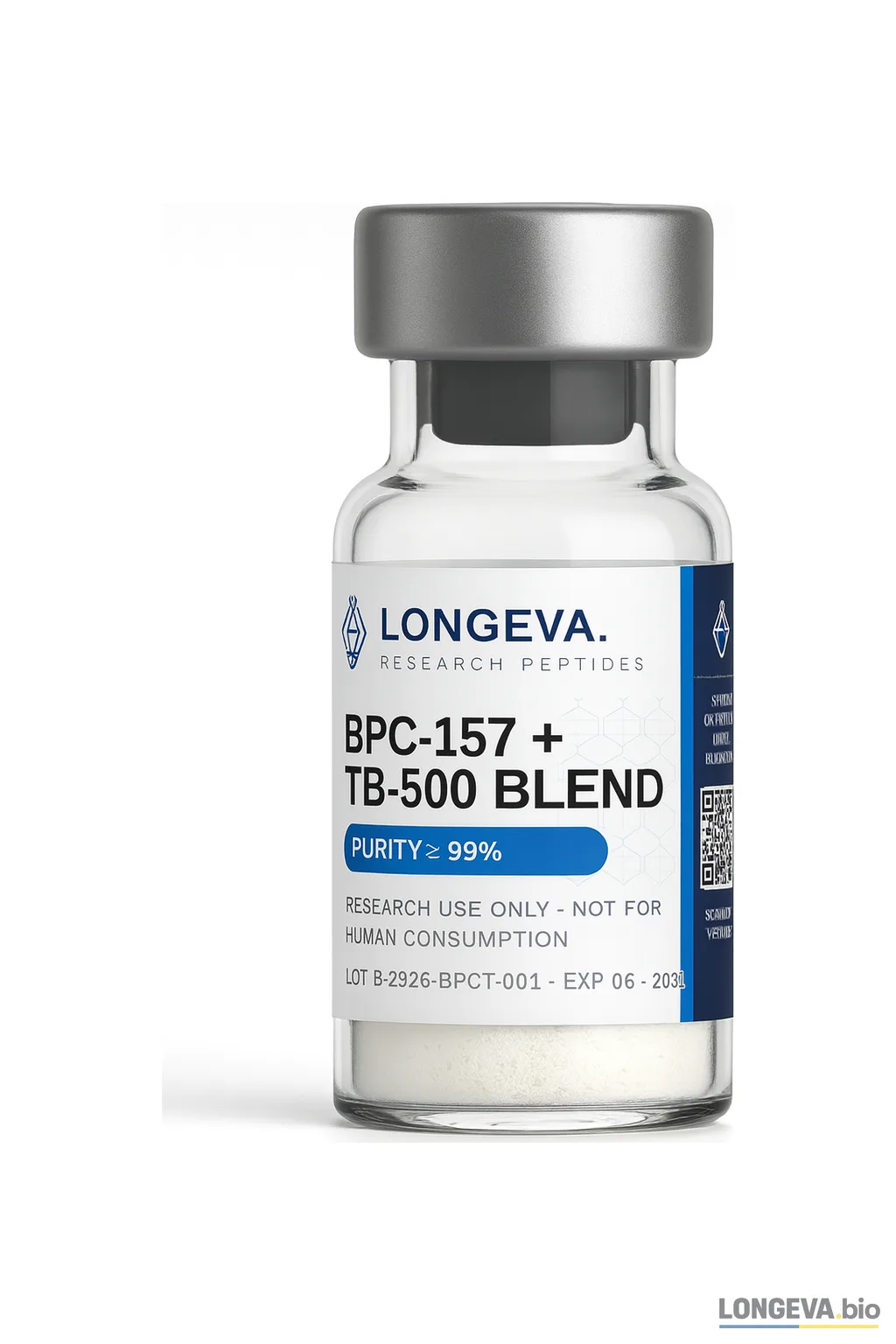
Longeva BPC-157 + TB-500 contains BPC-157 together with short-fragment TB-500, not full-length 43-amino-acid Thymosin Beta-4.
→ Longeva BPC-157 + TB-500 product
This distinction should be kept in mind when reading the literature: a study of full-length Tβ4 is not automatically a study of TB-500.
For a broader discussion of mechanisms and evidence limitations, see the BPC-157 + TB-500 research monograph.
BPC-157 is a separate peptide
BPC-157 is a synthetic 15-amino-acid peptide. It is neither full-length Tβ4 nor TB-500.
The BPC-157 + TB-500 blend therefore combines two distinct peptides. Combining them in one vial does not convert TB-500 into full-length Thymosin Beta-4, nor does it make Tβ4 research directly applicable to the blend.
How to distinguish TB-500 from full-length Tβ4
The sequence provides the clearest first check:
- full-length Thymosin Beta-4: 43 amino acids;
- TB-500: Ac-LKKTETQ, 7 amino acids;
- BPC-157: 15 amino acids.
A product label alone is therefore insufficient when "TB-500" and "Thymosin Beta-4" are used together. Sequence information and analytical documentation are needed to establish which compound is actually present.
Why the distinction matters for evidence
A substantial part of the published literature on Thymosin Beta-4 concerns the full-length 43-amino-acid peptide. FDA's review of TB-500 states that it did not identify clinical studies or human exposure data for TB-500 itself.
Accordingly, Tβ4 and TB-500 should be treated as related but distinct research compounds, and evidence for one should not be presented as direct evidence for the other.
References
- Low TL, Hu SK, Goldstein AL. Complete amino acid sequence of bovine thymosin beta 4: a thymic hormone that induces terminal deoxynucleotidyl transferase activity in thymocyte populations. PNAS. 1981. doi:10.1073/pnas.78.2.1162
- Sosne G, Qiu P, Goldstein AL, Wheater M. Biological activities of thymosin beta4 defined by active sites in short peptide sequences. FASEB J. 2010. doi:10.1096/fj.09-142307
- FDA. Pharmacy Compounding Advisory Committee (PCAC) Meeting materials, July 23-24, 2026 (TB-500-related bulk drug substances). fda.gov/media/193773/download
Research Use Only. This material is an informational description of research reagents. It is not medical advice and does not provide instructions for human use.